
Oil & Gas Security Cameras & Oilfield Surveillance Systems in Alberta
Triton Surveillance designs explosion-proof camera, alarm, and access control systems for Alberta's oil and gas industry, from remote drill sites on the Athabasca to downstream refineries in the Industrial Heartland. Since 2008, we've deployed Pelco ExSite Enhanced and equivalent explosion-proof cameras for hazardous locations, with thermal perimeter detection, cellular and satellite connectivity, and installation aligned with ATEX certifications and Canadian Electrical Code Section 18 where applicable. Triton can provide installers with common Alberta safety tickets (H2S Alive, CSTS, First Aid, WHMIS) and operator-specific orientations as required for each project. Final equipment selection depends on site classification, operator standards, and engineering or safety requirements.
Not sure what system you need? Tell us what you're trying to protect. We will recommend a practical system based on your site, risks, and budget, not the biggest system we can sell.
Request a Remote-Site Security AssessmentSecurity Challenges in Oil & Gas Operations
Alberta's oil and gas sector combines remote geography, hazardous environments, extreme weather, and high-value targets. Standard commercial security systems can't handle it. You need equipment and installers engineered for energy-sector conditions.
Remote, unmanned facilities. Well sites, compressor stations, battery sites, and pipeline rights-of-way often sit hours from the nearest town and operate unmanned for long stretches. Patrols are expensive and impractical across hundreds of kilometres of pipeline.
Extreme environmental conditions. Wide seasonal temperature swings, ice, dust, vibration from heavy machinery, and H2S exposure are demanding conditions for camera equipment. Equipment must be rated for hazardous atmospheres and operate continuously across Alberta's full climate range.
Equipment, fuel, and copper theft. Copper wire theft from oilfield and rural energy sites has risen sharply in Alberta in recent years, and remains a persistent loss for remote operators. Compression stations, well sites, and battery sites are the primary targets, along with tools, fuel, and production chemicals. Effective deterrence and rapid detection matter for both insurance recovery and RCMP investigation support.
HSE compliance and incident documentation. Operators need continuous monitoring for safety compliance, spill detection, flare monitoring, and worker safety verification. Security cameras double as safety-observation tools, providing documented evidence for incident investigations and AER regulatory audits.
Pipeline Security & Energy Sector Surveillance Solutions
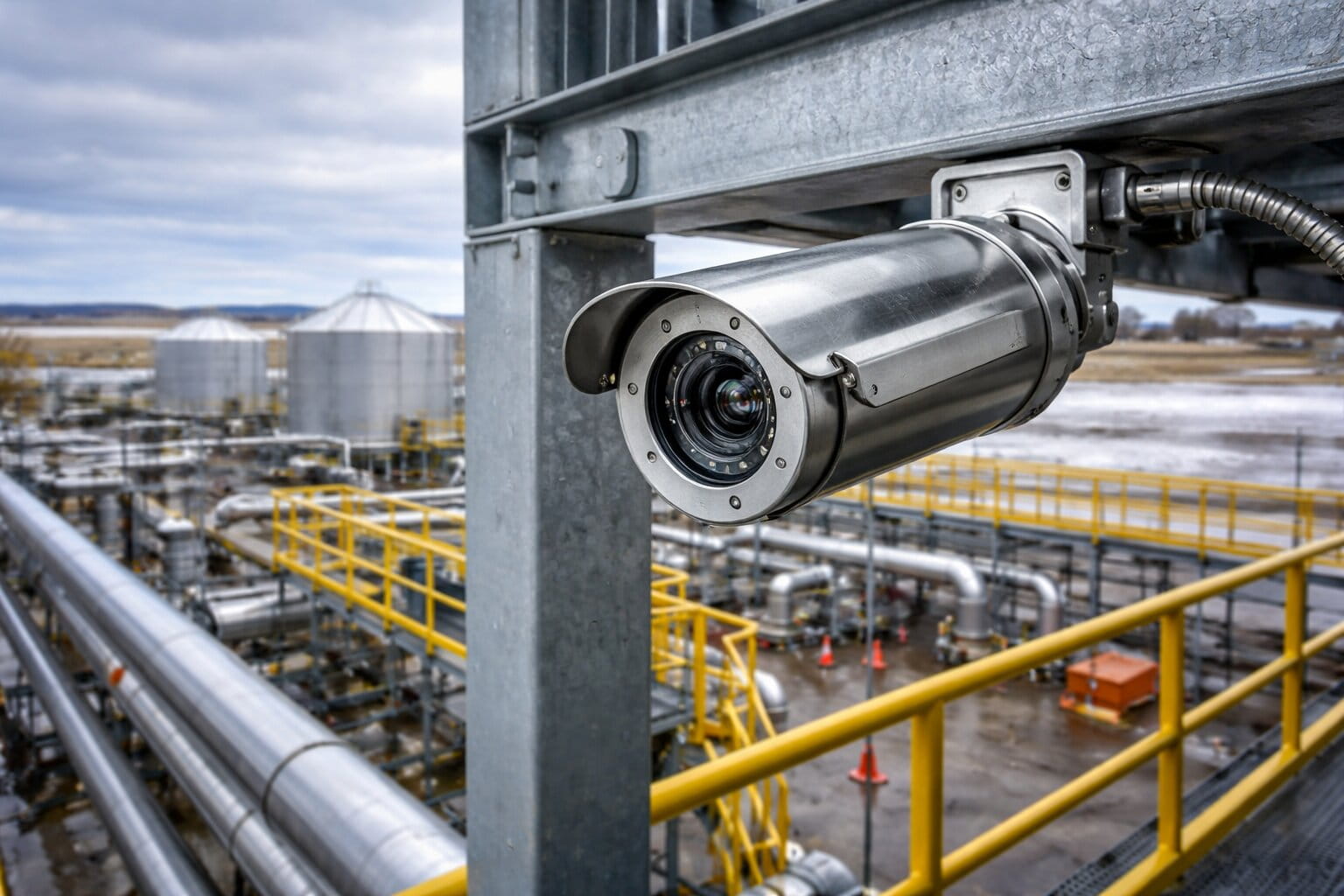
Every component (cameras, cabling, connectivity) is selected for performance in hazardous, remote, and extreme-temperature environments.
Explosion-proof cameras. For hazardous locations, Triton installs Pelco ExSite Enhanced cameras in pressurized stainless steel housings with HD/4K resolution, integrated IR illumination, and built-in lens wipers. Hazardous-location installs use conduit sealing, barrier fittings, and intrinsically safe power as required by CEC Section 18.
Thermal perimeter detection + PTZ wide-area coverage. Thermal cameras detect intruders, vehicles, and wildlife by heat signature regardless of fog, snow, or darkness. Industrial-grade PTZ cameras with high-power optical zoom cover entire well pads or tank farms from a single position, with auto-tracking that follows detected movement. Heated housings and heavy-duty mounts are specified for exposed, high-wind locations.
Cellular and satellite connectivity. For sites within cellular coverage, we deploy LTE/5G modems with high-gain directional antennas. For truly remote locations, Starlink or VSAT. Systems use event-driven clip uploads and adaptive compression for bandwidth-limited links.
Pipeline and right-of-way monitoring. Solar-powered fixed and relocatable camera stations watch pipeline corridors for third-party encroachment, ground disturbance, and unauthorized crossings, especially at valve sites, river crossings, and road crossings.
Integrated Alarm & Access Control
Cameras are most effective when layered with intrusion detection and access management on one unified platform.
Perimeter intrusion detection with visual verification. Fence-mounted vibration sensors, buried cable detection, and radar-based perimeter surveillance detect approaches before intruders reach critical assets. Triton integrates these alarms with PTZ cameras that automatically slew to the alarm location for instant visual confirmation, dramatically cutting false dispatches compared to alarm-only systems.
Restricted area access control. Card, fob, and mobile credential systems control entry to control rooms, chemical storage, and wellheads. Access rules can include time-of-day restrictions and safety prerequisites such as gas-detection clearance. Every event is logged with timestamp, identity, and associated camera footage.
Safety zone monitoring and ESD integration. Camera analytics monitor exclusion zones around operating equipment, confined-space entries, and hot work areas, alerting the supervisor when someone enters without authorization. Systems can interface with facility Emergency Shutdown (ESD) to trigger high-frame-rate recording and door state changes during incidents.
Compliance & Safety Requirements
Working in Alberta's oil and gas sector demands strict compliance with electrical codes, safety standards, and regulatory requirements. Triton Surveillance maintains full compliance across every aspect of our energy sector work.
- Hazardous-location rated equipment. Cameras and housings for hazardous locations are selected to carry the listings the classification requires, which may include UL, cUL or ATEX for use in explosive atmospheres containing flammable gases and vapours.
- Canadian Electrical Code compliance. Installations in hazardous locations follow Section 18 of the CEC, including explosion-proof conduit, sealing fittings, and intrinsically safe barriers.
- Alberta OHS Act compliance. Our installations support operator obligations under the Alberta Occupational Health and Safety Act, including workplace monitoring and incident documentation requirements.
- WCB coverage and safety tickets. For oil and gas and industrial sites, Triton can provide technicians with the safety documentation and site certifications required for the project, including common Alberta requirements such as H2S Alive, First Aid, CSTS, and WHMIS, and operator-specific orientations where applicable. Drug and alcohol testing is completed as required.
- Operator-specific site orientations. Triton staff complete all required operator orientations and comply with site-specific safety management systems for Suncor, CNRL, Imperial, Cenovus, MEG Energy, and other major Alberta producers.
Example: Remote Drilling Site Deployment
Situation: Multi-well pad site in the Peace River region, unmanned outside drilling operations, 45 min from the nearest town. Adjacent sites had been hit by copper theft and fuel siphoning.
Triton's solution: Four Pelco ExSite Enhanced explosion-proof PTZ cameras covering the pad, tank farm, and access road; two thermal perimeter cameras around the fence line; LTE cellular gateway with high-gain antenna; solar and battery sized for multi-day autonomous operation; key-fob access control at the main gate and control building; SCADA integration to the operator's Calgary control room.
Ready to Secure Your Business?
Tell us about your facility and we'll design a custom security solution within 48 hours.
Thank You!
We've received your request and will be in touch within 48 hours.
Or call directly: 1-888-707-8228
Frequently Asked Questions
What cameras are rated for hazardous oil & gas environments?
How do you monitor remote facilities without internet?
What safety certifications do your installers have?
Can cameras survive Alberta's extreme temperatures?
What does oil & gas security typically cost?
Related Security Solutions
Discuss Your Oil & Gas Site Security
Free on-site assessment. Engineering-grade quote in 48 hours. Installers with common Alberta safety tickets and operator-orientation requirements available per project.