
Outdoor Security Camera Systems for Edmonton & Alberta
Outdoor surveillance in Alberta requires more than simply choosing a weather-resistant camera. Temperature, moisture, lighting, mounting location, power, network access and the required viewing distance all affect equipment selection.
Triton designs outdoor camera systems around those conditions, including options for low-light coverage, infrared illumination, thermal imaging, remote locations and sites without convenient wired power or internet access. We have been installing outdoor cameras across Edmonton and Alberta since 2008.
Not sure what system you need? Tell us what you're trying to protect. We will recommend a practical system based on your site, risks, and budget, not the biggest system we can sell.
Request an Outdoor Camera Coverage ReviewIP67/IP68 Rated
Dust-tight, waterproof housings for any weather
Heated Housings
Thermostat-controlled heaters for -40°C operation
IR Night Vision
Clear footage up to 80m in complete darkness
Solar Options
Off-grid power for remote locations
Consumer and Commercial Cameras Compared
Every winter, Edmonton businesses discover the hard way that consumer-grade outdoor cameras are not designed for Alberta's climate. Cameras specified for milder climates are frequently deployed here and then fail, because the published operating range never covered Edmonton conditions in the first place.
Temperature ratings are the first problem. Consumer camera lines typically publish a much higher minimum operating temperature and a shorter warranty than commercial lines. Commercial cameras from Axis, Hanwha, and Pelco are rated to −30°C or colder and carry 3–5 year warranties. Edmonton routinely experiences sustained periods below −30°C, with wind chills pushing effective temperatures to −40°C and beyond. At these temperatures, consumer plastics become brittle, LCDs fail, and lithium batteries lose a substantial share of their usable capacity.
Condensation and frost destroy image quality. Consumer cameras lack the internal heaters and defoggers found in commercial units. When temperatures fluctuate (a common occurrence in Edmonton's chinook-prone climate), moisture condenses inside the camera housing and freezes on the lens. The result is fogged, frosted, or completely obscured footage during the exact conditions when security coverage is most critical.
Sealing and weatherproofing fall short. Consumer cameras typically carry IP65 ratings or lower, meaning they resist water jets but are not sealed against driving snow, ice accumulation, or the freeze-thaw cycles that pry apart seals over time. After one or two Edmonton winters, moisture intrusion causes corrosion, short circuits, and permanent failure.
The bottom line: Installing in Alberta since 2008, we are regularly called to replace cameras that were not specified for outdoor winter use. Triton installs commercial cameras specified for the conditions at the site. They are the smarter investment from day one.
Building an Outdoor Camera System for Alberta Conditions
The outdoor cameras Triton installs across Edmonton are engineered from the ground up for extreme environments. Housing, lens, electronics, cables, and connectors are each specified against the operating range expected at the site, rather than assuming the camera body alone determines cold-weather performance.
IP67 and IP68 ratings explained. The Ingress Protection (IP) rating system is the international standard for environmental sealing. IP67 means the camera is completely dust-tight (6) and protected against temporary immersion in water up to 1 metre (7). IP68 provides protection against continuous immersion and higher-pressure water exposure (8). Triton commonly specifies IP67 for outdoor installations, and IP68 for cameras in locations subject to direct precipitation, ice accumulation, or pressure-washing during maintenance.
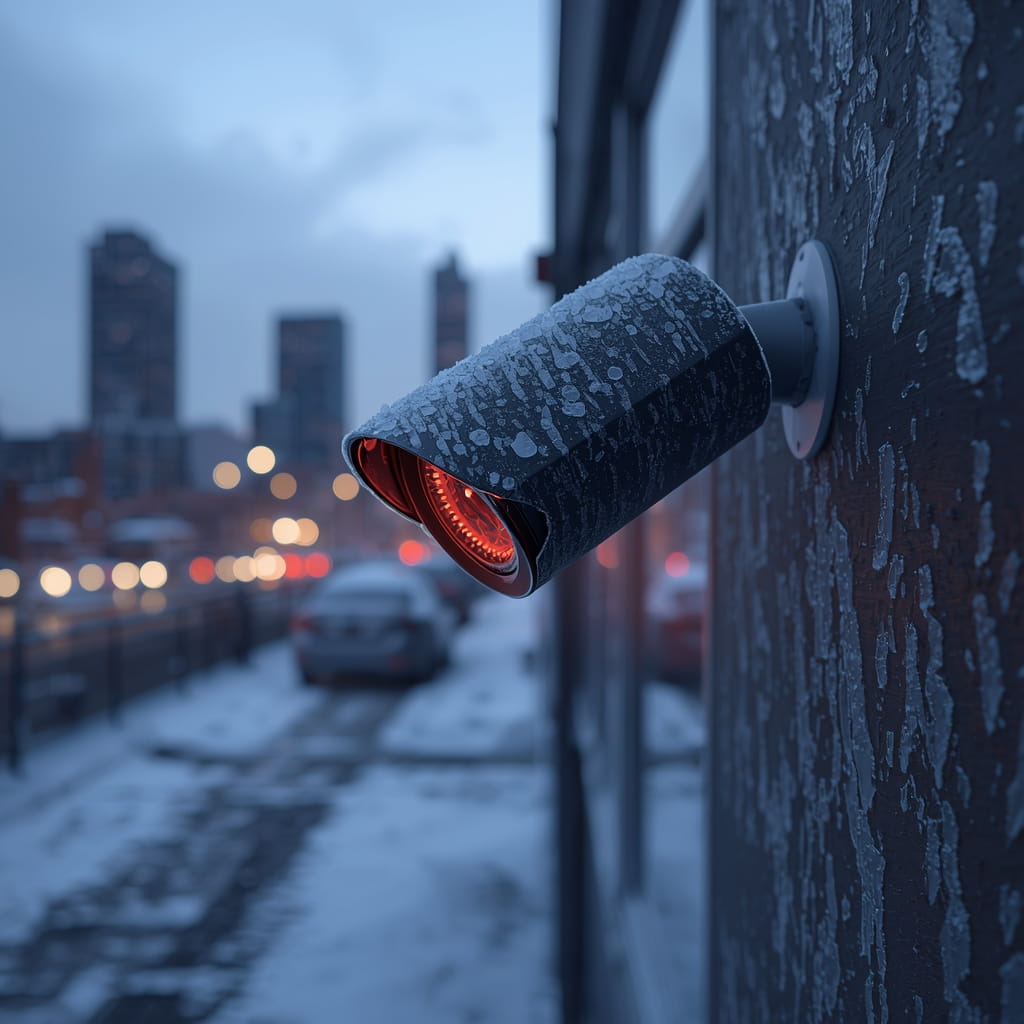
Heated housings are non-negotiable in Edmonton. Outdoor cameras are specified with a thermostatically controlled heater where the location requires one that activates automatically when the internal temperature drops below a set threshold (typically 0°C). These heaters maintain the camera's internal environment well above freezing, preventing frost on the lens, keeping lubricants fluid for PTZ movement, and ensuring electronics operate within their rated temperature range. For extreme cold installations, we use dual-heater housings and insulated mounting brackets that minimize thermal bridging to the cold mounting surface.
Internal defoggers work in conjunction with heaters to prevent condensation during rapid temperature changes. When a warm chinook pushes temperatures from -25°C to +5°C in a matter of hours (a common Edmonton phenomenon), defoggers ensure the lens stays clear while internal moisture is managed.
Vandal-resistant IK10 housings protect outdoor cameras from physical attack. The IK10 rating means the housing can withstand a 20-joule impact, equivalent to a 5 kg weight dropped from 40 cm. Triton recommends vandal-resistant IK10 housings for cameras mounted within reach, particularly in parking lots, alleys, and other areas where tampering is a risk.
Night Vision & Thermal Imaging for 24/7 Coverage
Edmonton experiences fewer than eight hours of daylight during the darkest weeks of December, meaning your outdoor cameras must perform in darkness for 16+ hours per day through much of winter. Triton designs outdoor systems to deliver clear, actionable footage around the clock with professional-grade night vision and thermal imaging technology.
Infrared (IR) LED night vision is standard on the outdoor cameras Triton specifies. IR LEDs emit light at wavelengths invisible to the human eye (typically 850nm or 940nm), illuminating the scene for the camera sensor without creating visible light. Standard IR cameras provide clear black-and-white footage at short to mid-range distances. High-power IR models with advanced LED arrays extend that range considerably, covering large parking lots, loading docks, and building perimeters.
Smart IR technology automatically adjusts LED intensity based on the distance of objects in the scene. When a person approaches a camera, smart IR dims the LEDs to prevent face washout, helping keep faces identifiable at the intended distance. This is a significant advantage over fixed-intensity IR, which often overexposes subjects at close range, exactly when identification matters most.
Thermal imaging cameras extend detection where lighting is the limiting factor. Rather than relying on any light source, thermal cameras detect the infrared radiation (heat) emitted by all objects. Thermal cameras provide long-range detection in low-light and no-light environments. Effective range depends on the camera, lens, weather and detection objective. For Edmonton businesses with large perimeters, critical infrastructure, or high-security requirements, thermal cameras provide detection capability that no conventional camera can match.
Triton often recommends a hybrid approach: thermal cameras for long-range detection and perimeter alerts, paired with conventional IR cameras for detailed identification footage at shorter ranges. When the thermal camera detects a heat signature, the system automatically slews a PTZ camera to the target for visual verification, giving you both early warning and evidence-quality video.
Solar Power and Remote-Site Deployment
Not every property has convenient access to conventional power and network infrastructure. Remote commercial properties, construction sites, agricultural operations, temporary event venues, and rural Alberta businesses often need surveillance in locations where trenching power and data lines is impractical or prohibitively expensive.
Triton designs and installs complete off-grid surveillance solutions using high-efficiency solar panels, deep-cycle battery banks, and cellular (4G/LTE) connectivity. These systems operate entirely independently of grid power and wired internet, making them deployable virtually anywhere in Alberta with cellular coverage.
Solar panel sizing is calculated based on Edmonton's specific solar irradiance data, accounting for seasonal variation. Edmonton receives approximately 2.5 peak sun hours per day in December and 6.5 peak sun hours in June. Triton sizes battery banks to provide 3-5 days of autonomous operation without any sunlight, ensuring reliable performance through extended cloudy periods and Alberta's shortest winter days.
Cellular connectivity provides remote access and cloud storage without any wired internet connection. Our solar camera systems use commercial-grade 4G/LTE routers with external antenna options for areas with marginal signal strength. Video is compressed and transmitted efficiently, keeping cellular data costs manageable while maintaining HD image quality for remote viewing and cloud recording.
Solar-powered camera systems are available as permanent installations or portable, trailer-mounted units that can be relocated as needed. The portable option is particularly popular with Edmonton construction companies monitoring multiple active sites, and with event organizers who need temporary surveillance for festivals, concerts, and outdoor gatherings.
Ready to Secure Your Business?
Tell us about your facility and we'll design a custom security solution within 48 hours.
Thank You!
We've received your request and will be in touch within 48 hours.
Or call directly: 1-888-707-8228
Outdoor Security Cameras: Frequently Asked Questions
What IP rating do outdoor cameras need in Edmonton?
How do cameras work at -40°C?
How far can outdoor security cameras see at night?
Can outdoor cameras be solar powered?
How often do outdoor cameras need maintenance?
Related Security Solutions
Get a Quote for Outdoor Cameras
Free on-site assessment. Custom quote in 48 hours. Equipment specified for Alberta operating conditions.