
Construction Site Security Cameras in Edmonton
Triton Surveillance provides rapid-deployment mobile security cameras for Edmonton construction sites: solar-powered units with cellular connectivity. In many Edmonton-area cases, units can be operational within 24–48 hours of project confirmation, depending on equipment availability, site access, and connectivity. Construction theft costs Canadian builders an estimated $46 million in insurance claims annually (Zurich Canada), and only about 1 in 4 stolen pieces of equipment is ever recovered. Tools, materials, heavy equipment, and copper wiring are the most frequent targets. Triton's temporary construction surveillance systems work as both visible deterrent and active monitoring, delivering live remote access, motion-triggered alerts, and cloud-recorded evidence with no on-site power or internet infrastructure needed. Since 2008 we've secured construction sites across Edmonton, Sherwood Park, St. Albert, and throughout Alberta.
Not sure what system you need? Tell us what you're trying to protect. We will recommend a practical system based on your site, risks, and budget, not the biggest system we can sell.
Request Temporary Site Camera Deployment24-48hr Deploy
Rapid deployment with no infrastructure needed
Solar Powered
No electrical hookup or generator required
4G/LTE Connected
Cellular connectivity for remote viewing anywhere
Project-Sized
Systems scoped to your project duration and footprint
Mobile Security Cameras for Construction: Rapid-Deploy Surveillance
Construction sites are dynamic environments where security needs change as rapidly as the project itself. Foundations are poured, walls go up, equipment moves in and out, and the site layout shifts weekly. Traditional wired security systems cannot keep pace with this constant evolution, which is why Triton Surveillance developed its rapid-deploy mobile surveillance platform specifically for Edmonton's construction industry.
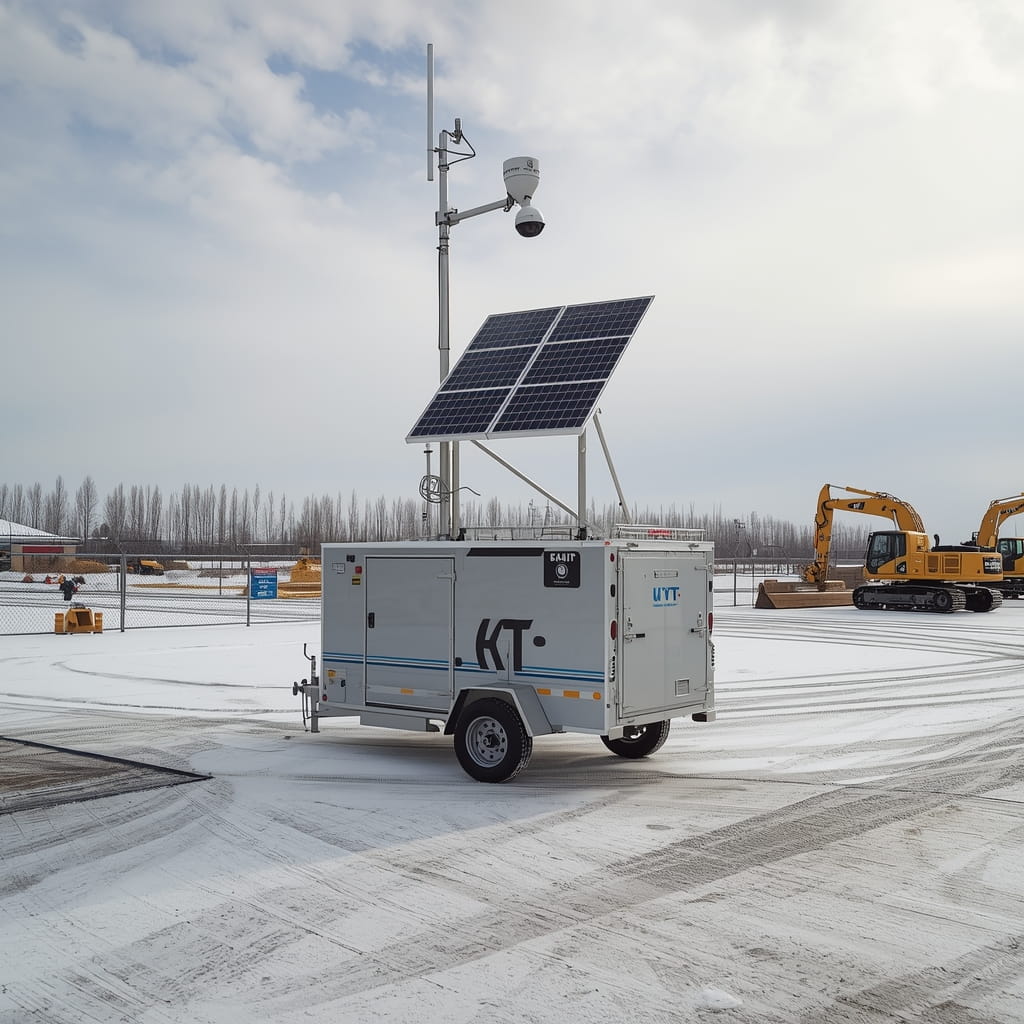
Trailer-mounted camera systems are the cornerstone of Triton's construction site solution. Each self-contained unit includes a telescoping mast that raises the cameras well above ground level, one or more commercial-grade PTZ cameras with infrared night vision, a high-efficiency solar panel array, a deep-cycle battery bank, and a 4G/LTE cellular router. The entire system is mounted on a lockable, towable trailer that can be positioned anywhere on the site and relocated as the project evolves.
No infrastructure required. Unlike wired systems that depend on electrical service and internet connectivity (utilities that are often unavailable during early construction phases), Triton's mobile units are fully self-sufficient. Solar panels charge the battery bank during daylight hours, and the cellular router provides a wireless connection for live streaming, remote access, and cloud recording. This means a camera can be monitoring your site before the first shovel breaks ground.
Deployment in 24-48 hours (typical). Once you confirm your project, Triton can deliver, position, and activate your mobile surveillance unit within 24-48 hours in many Edmonton-area cases, depending on equipment availability, site access, and connectivity. On-site setup takes approximately 2-4 hours, including mast extension, camera aiming, solar panel orientation, and remote access configuration. Your project manager receives login credentials for the mobile app and web portal before our team leaves the site.
Job Site Theft Prevention & Vandalism Deterrence for Edmonton Construction
Canadian construction theft costs builders an estimated $46 million in insurance claims every year (Zurich Canada), with only about 25% of stolen equipment ever recovered. Edmonton sites are targeted for tools, building materials (particularly copper wire and plumbing), heavy equipment, and temporary facilities.
Visible deterrence is the first line of defence. Triton's trailer-mounted camera systems feature prominently displayed cameras on elevated masts, high-visibility signage warning of active surveillance, and optional strobe lights that activate on motion detection. A 40-year meta-analysis of 76 studies (Piza, Welsh, Farrington & Thomas, 2019, Criminology & Public Policy) found CCTV reduces crime by about 13% overall, with substantially higher reductions when cameras are actively monitored rather than passively recorded.
Motion-triggered alerts provide active protection. When cameras detect movement during after-hours periods, the system sends instant push notifications to designated personnel, typically the project manager, site superintendent, and security company. Alerts include snapshot images and video clips so the recipient can immediately assess whether the activity is a genuine threat or a false alarm (such as an animal or blowing debris). This real-time alerting capability means that police or security response can be initiated within minutes of a breach, dramatically increasing the chances of catching perpetrators.
Evidence for recovery and prosecution. When theft does occur, high-definition recorded footage provides critical evidence for police reports, insurance claims, and criminal prosecution. Triton cameras capture HD video with timestamps and metadata suitable for insurance and police reporting. Our cloud storage ensures footage is preserved even if the camera itself is damaged or stolen during a theft event.
Time-Lapse & Project Documentation
Beyond security, construction cameras serve a valuable dual purpose as project documentation tools. Triton configures every construction camera to capture time-lapse photography alongside security footage, providing builders, developers, and project owners with a powerful visual record of the construction process.
Progress monitoring and reporting. High-resolution snapshots captured at configurable intervals (every 5, 15, or 60 minutes) create a comprehensive visual timeline of your project from ground-breaking to completion. Project managers use this imagery to monitor daily progress without visiting the site, verify that work is proceeding according to schedule, and create progress reports for clients, lenders, and stakeholders. The remote viewing platform allows authorized users to scroll through the timeline and compare current conditions to any previous date.
Professional time-lapse videos are compiled from the captured imagery and assembled into smooth, high-quality videos that compress months of construction into minutes. These videos are powerful marketing tools for developers and builders, showcasing your capability and craftsmanship. Many of Triton's construction clients use their time-lapse videos on websites, social media, and in client presentations.
Dispute resolution and liability protection. Construction disputes over scheduling, workmanship, and site conditions are common. Date-stamped photographic evidence from Triton's cameras provides objective documentation that can resolve disagreements before they escalate to litigation. If a subcontractor disputes when work was completed, or a client questions the timeline of a particular phase, the time-lapse record provides clear, timestamped proof.
Safety compliance documentation. Camera footage also serves as documentation of safety practices on site. In the event of a workplace incident, recorded footage can help investigators reconstruct events, verify compliance with safety protocols, and support WCB claims. This documentary value makes construction cameras an asset not just for security, but for overall project risk management.
How Triton Scopes Construction Site Security
Construction projects are custom-scoped sized to the site, duration, and risk profile. There's no one-size-fits-all package, and we never over-spec.
Site assessment first. A Triton specialist walks your site (or reviews drawings for projects not yet broken ground), maps risk points (lay-down areas, equipment yards, perimeter access), and identifies the right camera count and mast positions for the project duration.
Single-site or multi-site programs. For builders running multiple concurrent projects across Edmonton, we can design a program that moves camera units between sites as projects start and finish. You focus on building, we handle the security infrastructure logistics from first pour to final inspection.
Custom quote in 48 hours. After the assessment, you receive a written, itemized quote covering equipment, solar/cellular setup, cloud storage, remote-access licensing, installation labour, removal at project end, and any optional time-lapse or live monitoring add-ons.
Ready to Secure Your Business?
Tell us about your facility and we'll design a custom security solution within 48 hours.
Thank You!
We've received your request and will be in touch within 48 hours.
Or call directly: 1-888-707-8228
Construction Site Security Cameras: Frequently Asked Questions
How quickly can construction cameras be deployed?
Do construction site cameras need internet access?
Can construction cameras be solar powered?
What does construction site surveillance cost?
Can cameras provide time-lapse documentation?
How long does on-site setup take once the unit arrives?
Related Security Solutions
Secure Your Next Edmonton Construction Project
Free site assessment. Custom quote in 48 hours. Many Edmonton-area deployments completed within 24–48 hours of project confirmation.