
Access Control vs. Traditional Keys: Why Edmonton Businesses Are Switching
By the Triton Surveillance Team
Reviewed for technical accuracy by Chris Reilly, Co-Founder & Managing Director, Triton Surveillance Inc.
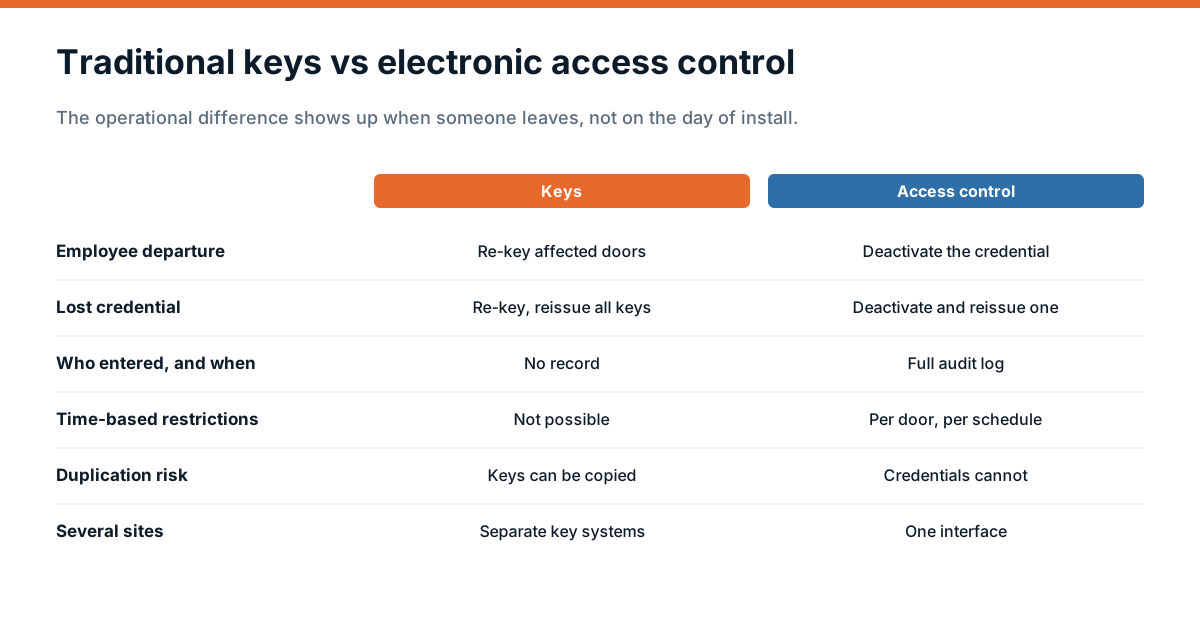
Every business with a door has a key management problem. Whether you run a retail store, a warehouse, a property management company, or a professional office, controlling who can enter your building (and knowing when they did) is fundamental to security. For decades, the solution was simple: metal keys and mechanical locks. But the limitations of traditional keying systems are pushing more Edmonton businesses toward electronic access control, and the switch is happening faster than most people realize.
This access control vs keys business guide compares traditional key systems to commercial access control in Edmonton on the metrics that matter to business owners: cost, security, convenience, and accountability.
The Hidden Cost of Traditional Keys
Traditional keys seem inexpensive. A key blank costs a few dollars, and a standard commercial lock is a modest purchase. But the real cost of key-based security is not in the hardware. It is in the ongoing operational burden that compounds over time. When a business relies on traditional keys, every employee departure triggers a re-keying decision, every lost key creates a security vulnerability, and every after-hours access request requires someone to physically hand over a key. For a business with even moderate employee turnover, the annual cost of re-keying, key duplication, lock replacement, and the administrative overhead of tracking key distribution routinely exceeds the cost of an electronic access control system within three to five years. And that calculation does not account for the security gaps that keys inherently create.
Re-Keying After Employee Departures
When an employee leaves your company (whether voluntarily or otherwise), you face a choice: re-key the locks they had access to, or accept the risk that a former employee retains access to your facility.
Professional re-keying in Edmonton carries a per-cylinder cost that adds up quickly across multiple locks. For a business with 10 exterior and interior locks, each employee departure triggers a meaningful expense. With multiple departures per year, the annual re-keying bill alone becomes significant, and that is for a relatively small operation. Multi-site businesses or those with high turnover (retail, hospitality, healthcare) face costs many times higher.
The uncomfortable truth is that many businesses do not re-key after every departure because of the cost and inconvenience. That means former employees, former contractors, and anyone they may have shared a key with potentially retains access to your building.
Master Key Vulnerability
Many commercial buildings use a master key system where individual keys open specific doors, but a master key opens everything. This is convenient for building managers but creates a severe vulnerability: if the master key is lost, copied, or stolen, every lock in the system is compromised. Replacing a master key system requires re-keying or replacing every lock core in the building, which can cost thousands of dollars and take days to complete.
No Audit Trail
When you hand someone a metal key, you have no idea when they use it. You do not know if an employee entered the building at 2 AM on a Sunday, if a cleaning contractor propped a door open for an hour, or if a key was used to let in an unauthorized person. Metal keys provide access but zero accountability.
Key Duplication
Any standard commercial key can be duplicated at a hardware store in minutes for a few dollars. You have no control over how many copies exist or who has them. Even "Do Not Duplicate" stamps on keys are not legally enforceable in most jurisdictions and do not prevent duplication at automated key-cutting kiosks.
What Keyless Entry Gives Your Business
Electronic access control replaces mechanical keys with credentials (key cards, fobs, PIN codes, mobile phone credentials, or biometrics) managed through a centralized system. Here is what that change means in practice.
Instant Credential Deactivation
When an employee leaves, their access credential is deactivated in seconds from a management console or mobile app. No locksmith visit. No re-keying. No wondering whether they made copies. This single feature eliminates the largest ongoing cost and security gap of traditional keying.
Time-Based Access Scheduling
With access control, you define not just who can enter, but when:
- Office staff can access the building Monday–Friday, 6 AM to 8 PM
- Cleaning crew can access Sunday and Wednesday, 9 PM to midnight
- Delivery drivers can access the loading dock weekday mornings only
- Management retains 24/7 access
This granularity is impossible with mechanical keys. A key either works or it does not. It does not know what day or time it is.
Complete Audit Logs
Every credential scan is logged with the user's identity, the door accessed, and the exact date and time. This creates a searchable record that is valuable for:
- Security investigations.Who was in the building when an incident occurred?
- Time and attendance verification.Supporting payroll accuracy
- Compliance documentation.Required in some regulated industries
- Liability protection.Proving or disproving claims about who was present at a given time
Remote Management
Cloud-connected access control systems allow you to manage access from anywhere:
- Lock or unlock doors remotely for deliveries, emergency responders, or late-arriving employees
- Grant temporary access to visitors or contractors without being on-site
- Monitor door status in real-time (open, closed, forced, held open)
- Receive alerts for unusual access patterns or security events
For property managers overseeing multiple buildings, remote management eliminates the need to physically visit each site to manage access changes.
Integration with Security Cameras
When access control is integrated with a camera system, every door event can trigger a video clip. If someone badges in at the back door at 3 AM, the system captures the associated video footage and links it to that access event. This combination of access data and visual verification is far more powerful than either system operating independently.
At Triton, we design integrated access control and surveillance solutions that give you a unified view of who is in your building and what they are doing.
Cost Comparison: Keys vs. Access Control Over 5 Years
Let us run the numbers for a hypothetical Edmonton business with 25 employees, two exterior doors, and five interior restricted doors (server room, stockroom, manager's office, etc.).
Traditional Keys: 5-Year Cost
| Cost Item | Annual Cost | 5-Year Total |
|---|---|---|
| Initial lock hardware | – | Moderate one-time cost |
| Re-keying (per departure across all locks) | Recurring cost per departure | Compounds significantly over 5 years |
| Key duplication (all employees) | Ongoing cost | Adds up with headcount |
| Lock replacements (wear, damage) | Periodic cost | Moderate over 5 years |
| Administrative time (key tracking, locksmith coordination) | Ongoing hidden cost | Significant over 5 years |
| Total | Often higher than expected. Contact us for a side-by-side comparison | |
Access Control: 5-Year Cost
| Cost Item | Annual Cost | 5-Year Total |
|---|---|---|
| System hardware and installation (7 doors) | – | Higher upfront investment (varies by scope) |
| Credential cards/fobs (25 initial + replacements) | Minimal ongoing cost | Low over 5 years |
| Software licensing (if applicable) | Modest annual fee | Moderate over 5 years |
| Maintenance and support | Modest annual fee | Moderate over 5 years |
| Total | Higher upfront, but often lower total cost of ownership. Request a custom comparison | |
The Real Comparison
On pure cost, the five-year numbers can be close, especially for smaller businesses. But the cost comparison misses the most important factor: security quality. The traditional key system leaves you vulnerable to unreturned keys, uncontrolled duplication, and zero visibility into who is accessing your building and when. Access control eliminates those vulnerabilities entirely.
For businesses with higher turnover, multiple locations, or regulatory compliance requirements, access control becomes decisively cheaper within 3–4 years, even before accounting for the security improvements.
Access Control Options for Different Business Sizes
Small Business (1–2 Doors, Under 20 Employees)
- Key card or fob readers on primary entrances
- Standalone or cloud-managed controller
- Cost: Contact for a quote tailored to your setup
- Best for: Retail stores, small offices, professional practices
Mid-Size Business (3–10 Doors, 20–100 Employees)
- Card readers with door schedules and zone management
- Networked controller with cloud management
- Integration with camera system
- Cost: Contact for a quote based on door count and features
- Best for: Multi-department offices, warehouses, medical clinics
Large or Multi-Site Business (10+ Doors, 100+ Employees)
- Enterprise access control platform
- Mobile credentials alongside card/fob options
- Elevator control, visitor management, and parking integration
- Full integration with surveillance and alarm systems
- Cost: Contact for an enterprise-level proposal
- Best for: Corporate offices, multi-tenant buildings, campus environments
Handling Employee Turnover
Employee turnover is where access control delivers its most dramatic advantage. Consider this scenario:
A retail business with 30 employees and 40% annual turnover (12 departures per year):
- With keys: 12 re-keying events across multiple locks each year creates a substantial recurring expense, plus the administrative burden and security risk from delayed re-keying
- With access control: 12 credential deactivations × 30 seconds each = 6 minutes/year of administrative time, with immediate security effect
The gap widens with every additional departure. Businesses with high turnover (retail, food service, construction, healthcare) see the fastest payback on access control investments.
Property Management: A Natural Fit
If you manage residential or commercial properties, access control solves problems that keys make nearly impossible to manage:
- Tenant turnover without re-keying entire common areas
- Contractor access limited to specific doors and specific time windows
- Common area management (gym, parking, amenity spaces) with usage tracking
- Emergency lockouts resolved remotely without sending someone with a key
- Detailed access records for liability protection and lease enforcement
We work extensively with Edmonton property management companies to design access control systems that reduce operational cost and improve tenant satisfaction.
Making the Switch
Transitioning from keys to access control does not have to happen all at once. Many Edmonton businesses start with their highest-priority doors (main entrances, server rooms, inventory areas) and expand the system over time as budget allows.
A phased approach typically looks like:
- Phase 1.Install readers on exterior doors and the most sensitive interior door. Establish the management platform. (Cost varies by scope. Contact us for a quote.)
- Phase 2.Add readers to remaining interior restricted areas. Integrate with existing camera system. (Cost varies by number of doors.)
- Phase 3.Add advanced features: mobile credentials, visitor management, elevator control. (Cost varies by features selected.)
Each phase delivers immediate value, and the system grows with your needs.
The Bottom Line
Traditional keys are familiar, but they are a 19th-century solution to a 21st-century problem. They cost more than most businesses realize, they create security gaps that compound over time, and they provide zero visibility into how your facility is being accessed.
Commercial access control in Edmonton costs more upfront but delivers lower long-term costs, dramatically better security, complete accountability, and the keyless entry convenience that keys simply cannot match. For Edmonton businesses with any meaningful level of employee turnover, restricted areas, or after-hours access needs, the switch is not a question of if. It is a question of when.
Ready to evaluate access control for your business? Contact Triton Surveillance for a free assessment. We will review your current setup, identify the highest-impact doors to control first, and provide a clear proposal with phased pricing options.