
How to Choose an Alarm Monitoring Company in Edmonton
By the Triton Surveillance Team
Reviewed for technical accuracy by Chris Reilly, Co-Founder & Managing Director, Triton Surveillance Inc.
An alarm system without monitoring is just a noisemaker. It might scare off an opportunistic intruder, but it does nothing to summon help, verify threats, or protect your business when no one is around to hear it. Professional alarm monitoring is what transforms a collection of sensors and sirens into an actual security system.
But not all monitoring companies are equal. In Edmonton, you have dozens of options ranging from national chains to local independents, and the differences in service quality, contract terms, and technology can significantly affect how well your business is protected.
This guide to choosing an alarm company in Edmonton covers what to evaluate, what to ask, and what to avoid when selecting commercial alarm monitoring in Alberta for your business.
Why ULC Certification Matters
The single most important credential for an alarm monitoring company in Canada is ULC (Underwriters Laboratories of Canada) certification. A ULC-listed monitoring station has been independently audited and verified to meet rigorous standards for equipment redundancy, operator training, physical security of the monitoring facility, communication pathway reliability, and emergency response procedures. When a monitoring station is ULC-listed, it means the facility has backup power systems capable of sustaining operations during extended outages, redundant communication paths so that a single point of failure cannot prevent alarm signals from being received, trained operators available around the clock with documented procedures for every alarm type, physical security measures that prevent unauthorized access to the monitoring facility, and regular third-party audits to verify ongoing compliance with these standards.
Why This Matters to Your Business
Many insurance companies require ULC-listed monitoring to qualify for premium discounts on commercial policies. If your monitoring company is not ULC-listed and you file a claim, your insurer may deny the discount retroactively or question whether your alarm system met the requirements of your policy.
Beyond insurance, ULC certification is your assurance that the monitoring centre will actually be operational when you need it. A non-certified monitoring company may cut corners on backup power, staffing, or equipment maintenance, and those corners you will not discover until an alarm goes unanswered.
Always verify ULC certification directly. Ask for the ULC listing number and verify it through ULC's public database. Some companies claim to be "ULC-certified" based on using ULC-listed equipment, but their monitoring station itself may not be listed.
Response Time Standards
When your alarm triggers, the clock starts. How quickly the monitoring centre processes the signal and contacts the appropriate parties determines whether the alarm is an effective security tool or just a logged event.
What to Expect
- Signal reception to operator acknowledgment: ULC standards require alarm signals to be acknowledged within 90 seconds. Many quality monitoring centres achieve 15–30 second acknowledgment times.
- Operator acknowledgment to dispatch or notification: After acknowledgment, the operator follows your predetermined response plan, typically calling your designated contacts and/or dispatching security or police. This should happen within 60–120 seconds.
- Total time from alarm to response initiation: A well-run monitoring centre should have your alarm verified and response initiated within 2–4 minutes.
Verification Protocols
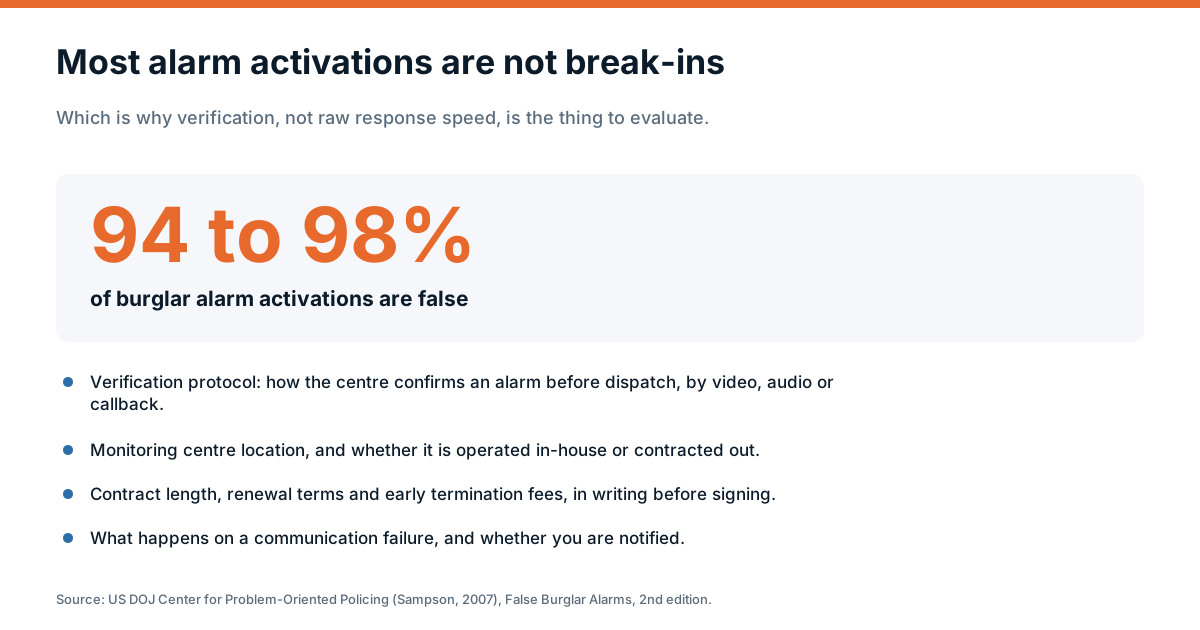
94 to 98 percent of burglar alarm activations are false alarms, according to the U.S. Department of Justice's Center for Problem-Oriented Policing. Modern monitoring companies use verification before dispatching police to reduce false alarm dispatches (which can result in fines from Edmonton Police Service). Verification methods include:
- Dual-signal verification.Waiting for a second sensor to trigger before dispatching
- Video verification.Accessing cameras at your site to visually confirm the alarm (requires camera integration)
- Phone verification.Calling your premises or designated contacts to confirm whether the alarm is legitimate
- App-based verification.Sending a push notification to your phone with options to confirm or cancel the alarm
Video verification is increasingly preferred because it provides the monitoring centre and responding officers with real-time information about what is happening, which improves response effectiveness and reduces false dispatches.
Monitoring Centre Location
Where your monitoring centre is physically located affects service quality in ways that are not immediately obvious.
Local Monitoring
A monitoring centre in Edmonton or Alberta offers:
- Familiarity with local geography.Operators know Edmonton addresses, neighbourhoods, and jurisdictions
- Relationships with local emergency services.Established communication channels with Edmonton Police, Fire, and EMS
- Awareness of local conditions.Understanding that a power outage in a specific neighbourhood may trigger multiple alarms simultaneously (not a crime wave)
- Same-timezone operation.Shift changes and peak staffing aligned with local business hours
Outsourced Monitoring
Some Edmonton alarm companies contract monitoring to centres in other provinces or even other countries. While these centres may be technically capable, they may lack local knowledge, which can affect response quality. An operator in Ontario may not know that a specific Edmonton address is in an industrial area versus a residential neighbourhood, which affects how they prioritize and route the response.
Ask where the monitoring centre is located. If it is not local, ask how they handle Edmonton-specific knowledge requirements.
Contract Terms: What to Watch For
Alarm monitoring contracts vary dramatically in their terms, and the contract is where many businesses get trapped with a provider that does not meet their needs.
Contract Length
- Month-to-month: Maximum flexibility. You can cancel anytime. Slightly higher monthly rates. Best for businesses that want to evaluate a provider before committing.
- 1-year contracts: A reasonable commitment that may earn a modest discount. Usually includes a 30–60 day cancellation notice requirement.
- 3-year contracts: Common in the industry. Offer lower monthly rates but lock you in for an extended period. May include significant early termination fees.
- 5-year contracts: Avoid these unless you have thoroughly vetted the provider and the monthly rate savings are substantial. Being locked into a poor provider for five years is costly in ways that extend beyond the contract payments.
Early Termination Fees
Read the termination clause carefully. Some contracts require you to pay the remaining balance of the entire contract term if you cancel early. On a long-term contract, early termination fees can add up to thousands of dollars, essentially paying for a service you are not receiving.
Automatic Renewal
Many contracts auto-renew for an additional term (often 1–3 years) if you do not provide written cancellation notice within a specific window (often 30–90 days before the contract end date). Mark your calendar well in advance.
Rate Increases
Does the contract allow annual rate increases? If so, are they capped? An uncapped annual increase clause on a 5-year contract can result in significantly higher payments by the end of the term.
What Changes the Monthly Monitoring Cost
Commercial alarm monitoring in Edmonton is usually offered at three service levels:
Entry-Level Monitoring
- Alarm signal reception and dispatch
- 24/7 monitoring centre support
- Phone notification of alarm events
- Basic reporting
Standard Monitoring
- Everything in basic monitoring
- Video verification integration
- Mobile app with alarm control and notifications
- Expanded contact lists and custom response plans
- Monthly activity reports
Premium Monitoring
- Everything in standard monitoring
- Active video monitoring during specified hours
- Two-way audio communication
- Advanced analytics and reporting
- Dedicated account manager
- Priority response
What Is Not Included
Monthly monitoring fees typically do not include:
- Equipment or installation.These are separate costs, sometimes financed through the monitoring contract
- Maintenance and repairs.Unless you have a separate service agreement
- False alarm fines.Fees levied by Edmonton Police Service for repeated false alarm dispatches
- Cellular communication fees.If your system uses cellular backup (a small additional monthly fee)
Hidden Fees to Watch For
Monitoring Centre Access Fees
Some companies charge extra to access your account online or through a mobile app. This should be included at no additional cost.
False Alarm Fees
Beyond municipal fines, some monitoring companies charge their own fee for processing false alarms. This can discourage reporting and create perverse incentives.
Service Call Charges
If your system malfunctions and needs repair, what does the monitoring company charge for a service call? Is there a minimum visit charge? Are parts included or billed separately?
Account Administration Fees
Some contracts include annual "administration" or "account maintenance" fees that are not part of the quoted monthly rate. These are pure profit adds. Negotiate them out.
Equipment Lease vs. Purchase
Some companies offer equipment at "no cost" but retain ownership. If you cancel, you may owe the equipment's full retail value or be required to return it (meaning a technician visit to decommission the system at your expense).
Self-Monitoring vs. Professional Monitoring
Modern alarm systems can send notifications directly to your smartphone, raising the question: do you really need professional monitoring?
Self-Monitoring Pros
- No monthly monitoring fees
- Immediate personal notification
- Direct control over response decisions
Self-Monitoring Cons
- You must respond to every alert personally.at 3 AM, during meetings, on vacation
- Delayed response.If your phone is silenced, dead, or you are in a poor signal area, the alarm goes unnoticed
- No dispatch authority.You must call 911 yourself, adding minutes to response time
- Alert fatigue.Repeated non-critical alerts lead to ignoring notifications
- Insurance implications.Most commercial policies require professional monitoring for premium discounts. Self-monitoring does not qualify.
The Pragmatic Answer
For most Edmonton businesses, professional monitoring is worth the cost. The monthly fee buys you reliable 24/7 response capability that does not depend on one person's phone being charged and within reach. Self-monitoring can supplement professional monitoring but should not replace it for commercial applications.
Questions to Ask Before Signing
Use this checklist when evaluating alarm monitoring companies:
- Are you ULC-listed? Ask for the listing number and verify it.
- Where is your monitoring centre? Ask for the physical location.
- What is your average alarm response time? Ask for documented statistics, not just a claimed standard.
- Do you support video verification? This is increasingly important for reducing false dispatches.
- What are the contract terms? Length, auto-renewal, termination fees, rate increase provisions.
- What is included in the monthly fee? Get a written breakdown of what is and is not included.
- Who owns the equipment? Ensure you own what you pay for.
- What happens if I move locations? Can the contract transfer to a new address?
- Do you provide maintenance and repair services? What are the costs and response times?
- Can I see a sample monitoring report? This shows the level of detail you will receive about alarm events.
Red Flags in Alarm Monitoring Contracts
Walk away from any provider that exhibits these warning signs:
- High-pressure sales tactics.Insisting you sign today or lose a "special rate"
- Reluctance to provide contract details before signing
- 5+ year contract requirements with no shorter options
- Vague answers about ULC certification or monitoring centre location
- "Free" equipment that is actually leased with ownership retained by the company
- No option for month-to-month service after the initial contract term
- Negative reviews mentioning poor response times or difficulty cancelling
Triton's Commercial Alarm Monitoring Approach in Edmonton
At Triton Surveillance, we offer professional alarm monitoring designed for Edmonton businesses who want reliable protection without the contract traps:
- ULC-listed monitoring centre with verified credentials
- Flexible contract terms including month-to-month options
- Video verification capability integrated with your camera system
- Transparent pricing with no hidden fees or surprise charges
- Local knowledge and established relationships with Edmonton emergency services
- Equipment you own.we install it, you own it, no lease games
We also design and install commercial alarm systems that integrate with your existing surveillance and access control infrastructure for unified security management.
Making Your Decision
Choosing an alarm monitoring company is a decision you will live with for years. Take the time to get multiple quotes, read contracts thoroughly, verify credentials, and ask hard questions. The cheapest option is rarely the best value, and the most expensive option is not automatically the best either.
The right monitoring company is one that protects your business reliably, treats you fairly in their contract terms, and provides transparent service that you can verify. That is what we aim to deliver at Triton, and it is what you should demand from whoever you choose.
Need help choosing alarm monitoring in Edmonton? Contact Triton Surveillance for an honest conversation about what your business needs from commercial alarm monitoring in Alberta and what it should cost.