
Security Camera Laws in Alberta: What Business Owners Need to Know
By the Triton Surveillance Team
Reviewed for technical accuracy by Chris Reilly, Co-Founder & Managing Director, Triton Surveillance Inc.
Installing security cameras at your business is a significant investment in safety and loss prevention. But in Alberta, how you deploy those cameras (where they point, what they record, and how you handle the footage) is governed by privacy legislation that carries real consequences for non-compliance.
This guide to security camera laws in Alberta covers the key PIPA surveillance regulations that apply to commercial camera use. It is the practical framework on business camera privacy laws every Edmonton business owner should understand before installing or expanding a camera system.
PIPA: The Governing Legislation
Alberta's Personal Information Protection Act (PIPA), SA 2003, c P-6.5 is the primary legislation governing how private-sector organizations collect, use, and disclose personal information, including video surveillance footage. Under PIPA, video recordings that can identify an individual are classified as personal information, which means businesses operating security cameras in Alberta must comply with specific requirements around purpose, consent, notification, and retention.
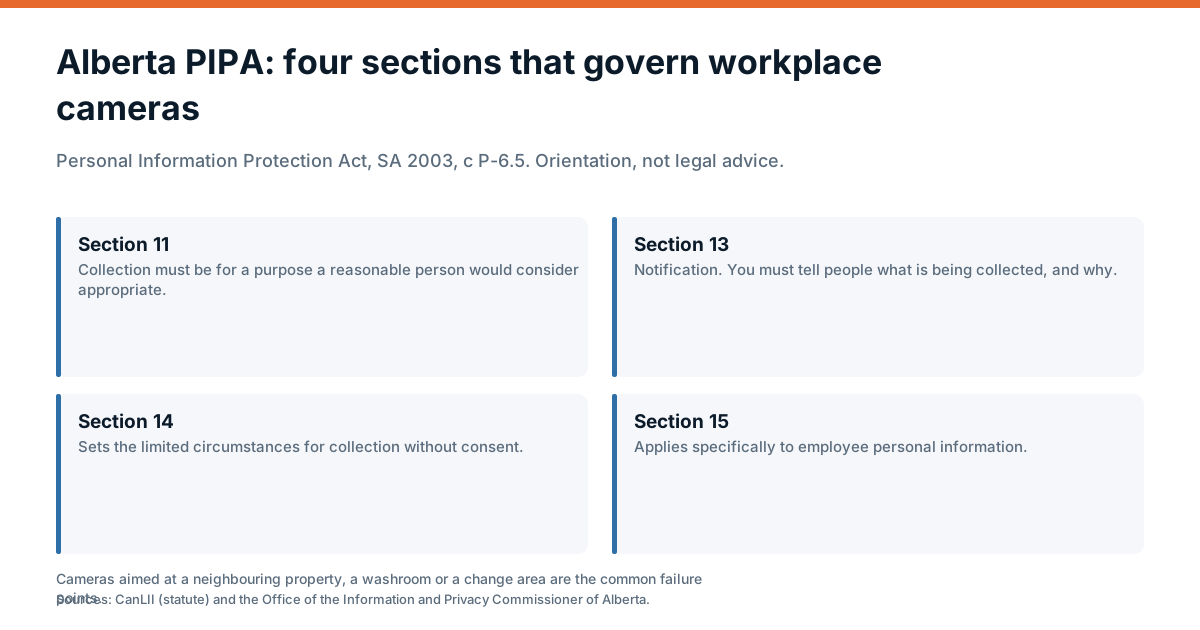
The key sections that govern commercial CCTV are:
- s. 11. Reasonable purpose. You may only collect personal information for purposes that a reasonable person would consider appropriate in the circumstances. For cameras, this means a documented security or loss-prevention rationale.
- s. 13. Notification. Individuals must be notified that recording is occurring, with clear visible signage at every entry to a recorded area.
- s. 14. Collection without consent. Limited grounds under which personal information can be collected without explicit consent. This is the operative section for ordinary commercial surveillance.
- s. 15. Employee monitoring. Personal employee information can be collected without consent only for reasonable purposes related to establishing, managing, or terminating the employment relationship.
For Triton's PIPA-compliance approach, see the Alberta OIPC Video Surveillance Guidelines. Unlike some provinces that rely on federal privacy legislation (PIPEDA), Alberta's PIPA provides specific provincial standards that may differ from federal requirements. If your business operates across provincial borders, you may need to comply with both.
What You Can and Cannot Record
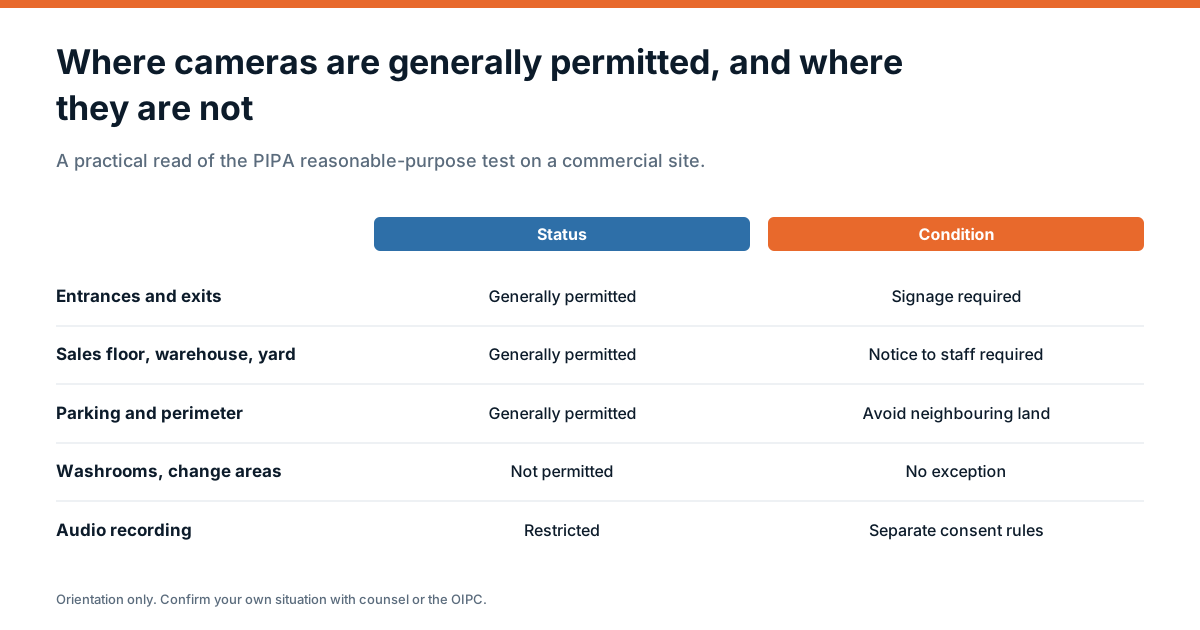
Generally Permitted
- Public entrances and exits.Recording who enters and leaves your premises is a core security function and is generally considered reasonable.
- Retail sales floors.Camera coverage of areas where customers browse and transactions occur is standard and expected.
- Parking lots and exterior perimeters.Monitoring your property's perimeter for security purposes is permitted.
- Loading docks and shipping areas.High-value and high-risk areas where theft and safety incidents commonly occur.
- Cash handling areas.Registers, safes, counting rooms, and other areas where money is handled.
- Warehouses and storage areas.Monitoring inventory storage is a legitimate loss prevention purpose.
Restricted or Prohibited
- Washrooms and change rooms.Recording in areas where individuals have a reasonable expectation of privacy is prohibited. This is absolute, with no exceptions for security purposes.
- Break rooms and lunch rooms.These are grey areas. Cameras aimed at entrances may be acceptable, but cameras monitoring employees during personal break time are generally considered unreasonable.
- Union activity areas.Cameras positioned to monitor union meetings or organizing activities invite serious legal challenges.
- Private offices.A camera inside a private office occupied by one employee raises significant privacy concerns unless there is a specific, documented security justification (such as a cash-handling function).
Neighbouring Properties
Your cameras must not capture areas beyond your property without justification. If a camera's field of view includes a neighbouring business, residential property, or public space beyond what is incidental to monitoring your own property, you may be collecting personal information of individuals who have no relationship with your business and no reasonable expectation of being recorded by you.
Privacy masking features in modern cameras allow you to block out areas of the camera's view that extend beyond your property. At Triton, we configure privacy masks where the site requires them to ensure cameras capture only what they should.
Employee Notification Requirements
PIPA requires that employees be notified about workplace surveillance. This is not optional, and the notification must be meaningful, not buried in page 47 of an employee handbook.
What Notification Must Include
- The fact that cameras are in use.Employees must know they are being recorded.
- Where cameras are located.Employees should know which areas are under surveillance.
- The purpose of recording.Security, loss prevention, health and safety, or other legitimate business purposes.
- Who has access to footage.Typically management, security personnel, and law enforcement when required.
- How long footage is retained.Your retention period (e.g., 30 days).
How to Notify Employees
Best practices for employee notification include:
- Written policy distributed to all employees and included in onboarding materials
- Acknowledgment form signed by each employee confirming they have been informed
- Visible signage in areas under camera coverage (see signage section below)
- Regular reminders when camera coverage is expanded or policies change
For unionized workplaces, camera installation and surveillance policies may be subject to collective bargaining. Consult with labour relations counsel before installing cameras in unionized environments.
Signage Requirements
Alberta law requires that individuals be notified they are under surveillance before they enter a recorded area. In practice, this means clear, visible signage.
What Signs Must Communicate
Effective surveillance signage should include:
- A clear statement that video surveillance is in operation."This area is under 24-hour video surveillance" or similar plain-language notice
- The purpose of the surveillance."For the safety and security of our customers and staff"
- Contact information.A name, phone number, or position title (e.g., "Contact the Security Manager at 780-XXX-XXXX") for inquiries about the surveillance program
- The organization's identity.Your business name
Where to Post Signs
- At every public entrance to your premises
- At the perimeter of outdoor camera coverage (parking lot entrances, for example)
- In employee areas under camera coverage
- At any point where a person would transition from an unrecorded area to a recorded area
Signs should be placed at eye level, in a size and font that is easily readable, and in languages appropriate for your clientele if you serve non-English-speaking communities.
A Common Mistake
Small "Smile, you're on camera" stickers on a front door do not constitute adequate notice. Signage must be clear, specific, and provide a contact point for privacy inquiries. Generic novelty signs do not meet PIPA's notification requirements.
Audio Recording Laws in Alberta
This is where many business owners unknowingly break the law. Video and audio recording are governed by different rules in Alberta.
The One-Party Consent Rule
Under the Criminal Code of Canada, audio recording requires the consent of at least one party to the conversation. For security cameras, this means:
- If your camera records audio of a conversation you are not part of, and no party to that conversation has consented to the recording, you may be violating wiretapping provisions of the Criminal Code (Section 184). This is a criminal offence, not just a privacy complaint.
- Most commercial security cameras should have audio recording disabled unless there is a specific, justified reason to record audio and appropriate consent mechanisms are in place.
Practical Recommendation
For the vast majority of commercial security applications, disable audio recording on all cameras. The legal risk far outweighs any security benefit. Video footage alone is sufficient for virtually all security, loss prevention, and liability purposes.
If you have a specific need for audio recording (e.g., a late-night retail environment where verbal threats are a concern), consult with a privacy lawyer before enabling it. You will need documented consent mechanisms and a clear justification.
Data Retention Guidelines
PIPA does not specify an exact retention period for surveillance footage, but it establishes principles that determine how long you should keep recordings:
Retention Best Practices
- Minimum retention: 30 days.This allows time to discover incidents and review footage. Most insurance companies and law enforcement agencies expect at least 30 days of available footage.
- Maximum recommended retention: 90 days for most businesses. Keeping footage longer than necessary increases your data protection obligations and storage costs without proportionate benefit.
- Extended retention for specific incidents.If footage captures an incident that may lead to a claim, investigation, or legal proceeding, that footage should be preserved separately until the matter is resolved.
Automatic Overwriting
Most NVR systems are configured to automatically overwrite the oldest footage when storage reaches capacity. This is an acceptable practice as long as your storage is sized to meet your minimum retention requirement. A system configured for 30-day retention that runs out of space in 18 days due to undersized storage is a compliance issue.
Footage Access and Disclosure
Under PIPA, individuals have the right to request access to their own personal information, including security camera footage of themselves. Your business must have a process to handle access requests, which may include:
- Verifying the requester's identity
- Locating the relevant footage
- Providing access within a reasonable timeframe (PIPA specifies 45 days)
- Redacting other individuals' personal information from the footage if necessary
Privacy Impact Assessments
For larger businesses or those with extensive camera coverage, conducting a Privacy Impact Assessment (PIA) is strongly recommended. A PIA documents:
- What personal information is collected and how
- The purpose and justification for each camera location
- How information is protected (physical security of NVR, network security, access controls)
- Retention and destruction policies
- Risks and mitigation measures
While a PIA is not legally mandatory for most private businesses in Alberta, it demonstrates due diligence and provides a defensible framework if a privacy complaint is filed.
Real-World Examples of What Is Allowed
Retail Store
A clothing retailer installs cameras covering the sales floor, fitting room entrances (not interiors), cash registers, stockroom, and back door. Signs are posted at both customer entrances and the employee entrance. Employees receive written notification during onboarding. Audio recording is disabled. Footage is retained for 30 days. This is compliant.
Office Building
A property management company installs cameras in the lobby, parkade, elevator lobbies, and exterior perimeter of a multi-tenant office building. Signs are posted at building entrances, parkade entrances, and elevator lobbies. Tenants are notified in their lease agreements. Cameras do not cover individual tenant suites. This is compliant.
Restaurant
A restaurant owner installs a camera in the kitchen pointed at the food preparation area for health and safety reasons, plus cameras covering the dining room, bar area, and exterior entrances. A camera in the employee break area captures the time clock only. Signs are posted at entrances. This is generally compliant, though the break area camera should be carefully positioned to avoid capturing personal break activities.
What Would Not Be Compliant
A warehouse owner installs hidden cameras without signage, records audio, does not notify employees, and keeps footage indefinitely with no access controls. This violates multiple PIPA requirements and potentially the Criminal Code regarding audio recording. The owner would face complaints to the Alberta Information and Privacy Commissioner, potential fines, and possible criminal charges.
How Triton Helps Edmonton Businesses Stay Compliant with Camera Privacy Laws
Compliance is part of how we design camera systems. At Triton Surveillance, our installation process includes:
- Privacy-conscious camera positioning that covers security-critical areas while respecting restricted zones
- Privacy masking configuration to block out neighbouring properties, restricted areas, and other zones that should not be recorded
- Audio recording disabled by default on all camera installations
- Signage guidance including what your signs need to say and where they should be posted
- Retention configuration to match your business requirements and legal obligations
- Written documentation of your system layout for your records
We work with commercial clients across Edmonton who need their camera systems to protect their businesses while respecting the law. If you are unsure whether your current system meets Alberta's requirements, we can conduct a compliance review during a site visit.
Consequences of Non-Compliance
Privacy complaints in Alberta are investigated by the Office of the Information and Privacy Commissioner (OIPC). Consequences can include:
- Orders to change practices.You may be required to remove cameras, change positions, or modify policies
- Orders to destroy footage.Improperly collected footage may be ordered destroyed
- Public disclosure.OIPC investigation reports are published, which can damage your business reputation
- Fines.PIPA allows for fines up to $100,000 for individuals and $500,000 for organizations
- Civil lawsuits.Individuals whose privacy has been violated may pursue civil action for damages
The cost of doing surveillance right from the start is a fraction of the cost of defending a privacy complaint after the fact.
Key Takeaways
- PIPA classifies video footage as personal information.treat it accordingly
- Post clear, specific signage at all entrances to recorded areas
- Notify employees in writing and get acknowledgment signatures
- Disable audio recording unless you have legal advice supporting it
- Retain footage for 30–90 days, not indefinitely
- Respect restricted areas.no cameras in washrooms, change rooms, or areas with a high expectation of privacy
- Use privacy masking to exclude neighbouring properties from your camera views
- Have a process for handling footage access requests
Compliance with security camera laws in Alberta is not complicated when it is built into the system design from the beginning. At Triton Surveillance, it is standard practice, not an afterthought. Learn more about our approach or contact us for a compliant camera system design that meets all PIPA surveillance regulations.